

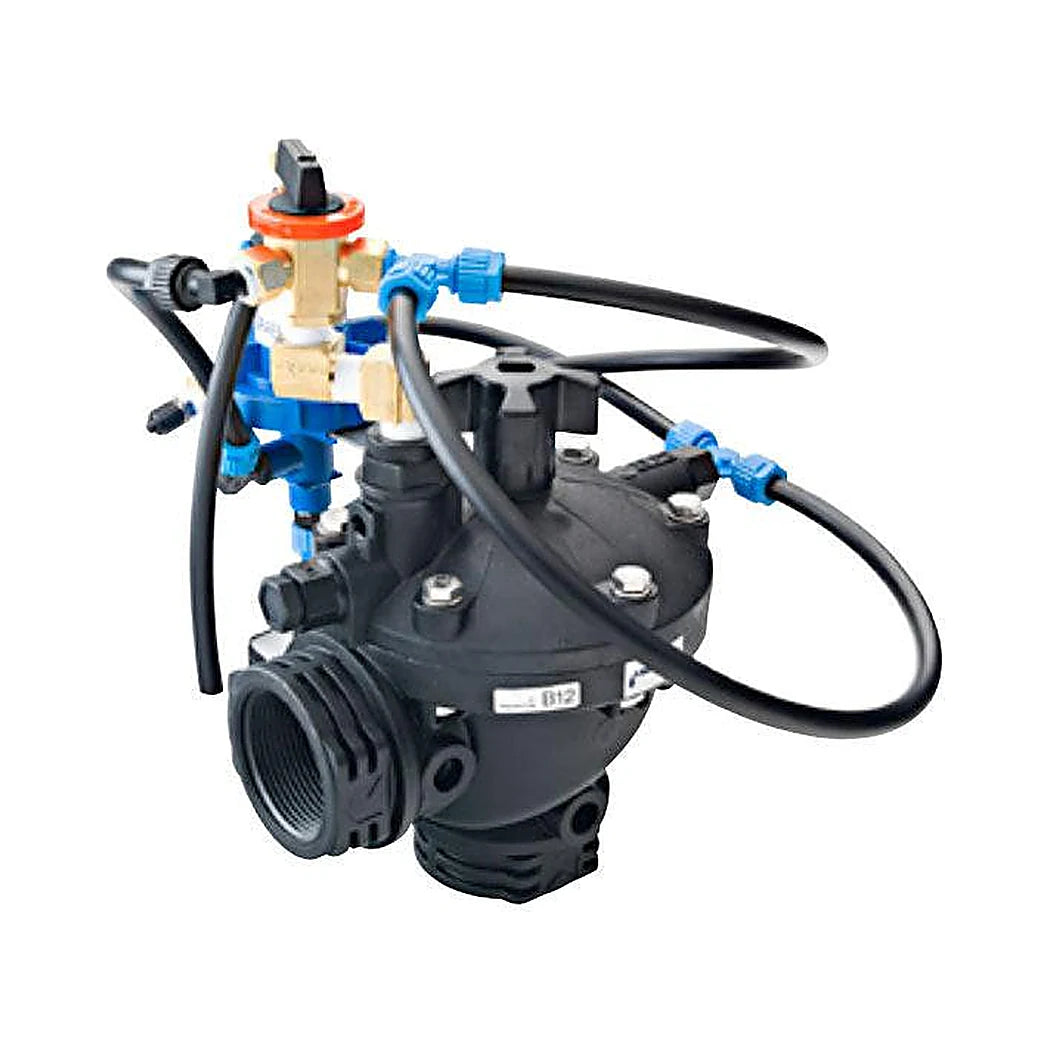
Netafim Pressure Reducing Valve for 1-1/2 in Drip Blocks
Pressure-compensating emitters still have a ceiling, and a supply that swings above it wears them out. This Series 80 valve sits at the head of a block and holds a preset downstream pressure, regardless of what the mainline does. A 3-way pilot mounted on the bonnet reads outlet pressure and trims the main diaphragm. When outlet pressure falls below the set point, the pilot lets the valve open wider; when it climbs, the valve throttles back. It is hydraulic, item 71610-014388, with no solenoid, so it regulates whenever water is in the line. The 1-1/2 in angle body carries 0.25 to 110 GPM and accepts 7 to 150 psi upstream, with water up to 140°F. Losses through the valve itself are small, about 0.7 psi at 40 GPM and 3.0 psi at 90 GPM fully open. Body, bonnet and seat are glass-reinforced polyamide with 304 stainless hardware and a 302 stainless spring. The housing measures about 3-1/2 x 6-1/2 x 6-13/16 in and weighs 1.8 lb. Pilot springs come in three colours, each setting a range: yellow 7-30 psi, green 14-65 psi and red 30-90 psi.
Setting Up a 3-Way Angle Control Valve on a Riser
Put it where one supply splits into blocks that need a lower, steadier pressure than the main can give them. Common spots are the head of a drip zone fed from a well pump, or a nursery bench line hanging off a high-pressure municipal main. The angle body lets it sit right on top of a riser, so the outlet turns sideways with no elbow in the way. Once it is plumbed, open the supply slowly so the valve fills without a pressure spike. Then turn the pilot adjustment while watching a gauge downstream until the block reads its target. Small changes matter, so adjust in short steps and let the gauge settle. A 3-way angle control valve like this can be installed upright or on its side, which helps in a tight valve box. It does not switch the zone on and off by itself. Pair it with an electric valve or a controller-driven master valve when the block also needs scheduling. Check the set point every season, because pilots drift slightly as diaphragms age.
Key Features
- Pressure reducing pilot: Holds a preset outlet pressure whatever the upstream supply or flow is doing.
- 3-way control on the bonnet: Pilot and controls mount on the bonnet, keeping the valve compact and serviceable.
- Angle body: Turns the flow from a bottom inlet to a side outlet, removing an elbow on the riser.
- 0.25-110 GPM range: Regulates a small drip block or a large multi-lateral zone on one valve.
- Three pilot spring ranges: Yellow, green and red springs cover set points from 7 up to 90 psi.
- Vertical or horizontal mounting: Fits upright on a riser or on its side in a crowded valve box.
Technical Specifications
| Specification | Value |
|---|---|
| Item Number | 71610-014388 |
| Function | 3-way hydraulic pressure reducing |
| Configuration | Angle |
| Size | 1-1/2 in threaded |
| Recommended Flow Range | 0.25-110 GPM |
| Operating Pressure | 7-150 psi |
| Maximum Water Temperature | 140°F |
| Pressure Loss (fully open) | 0.2 psi at 20 GPM; 0.7 psi at 40 GPM; 3.0 psi at 90 GPM |
| Pilot Spring Ranges | Yellow 7-30 psi; Green 14-65 psi; Red 30-90 psi |
| Installation | Vertical or horizontal |
| Body, Bonnet, Seat | Glass-reinforced polyamide |
| Hardware | Stainless steel 304 |
| Spring | Stainless steel AISI 302 |
| Dimensions (L x W x H) | 3-1/2 x 6-1/2 x 6-13/16 in |
| Weight | 1.8 lb |