


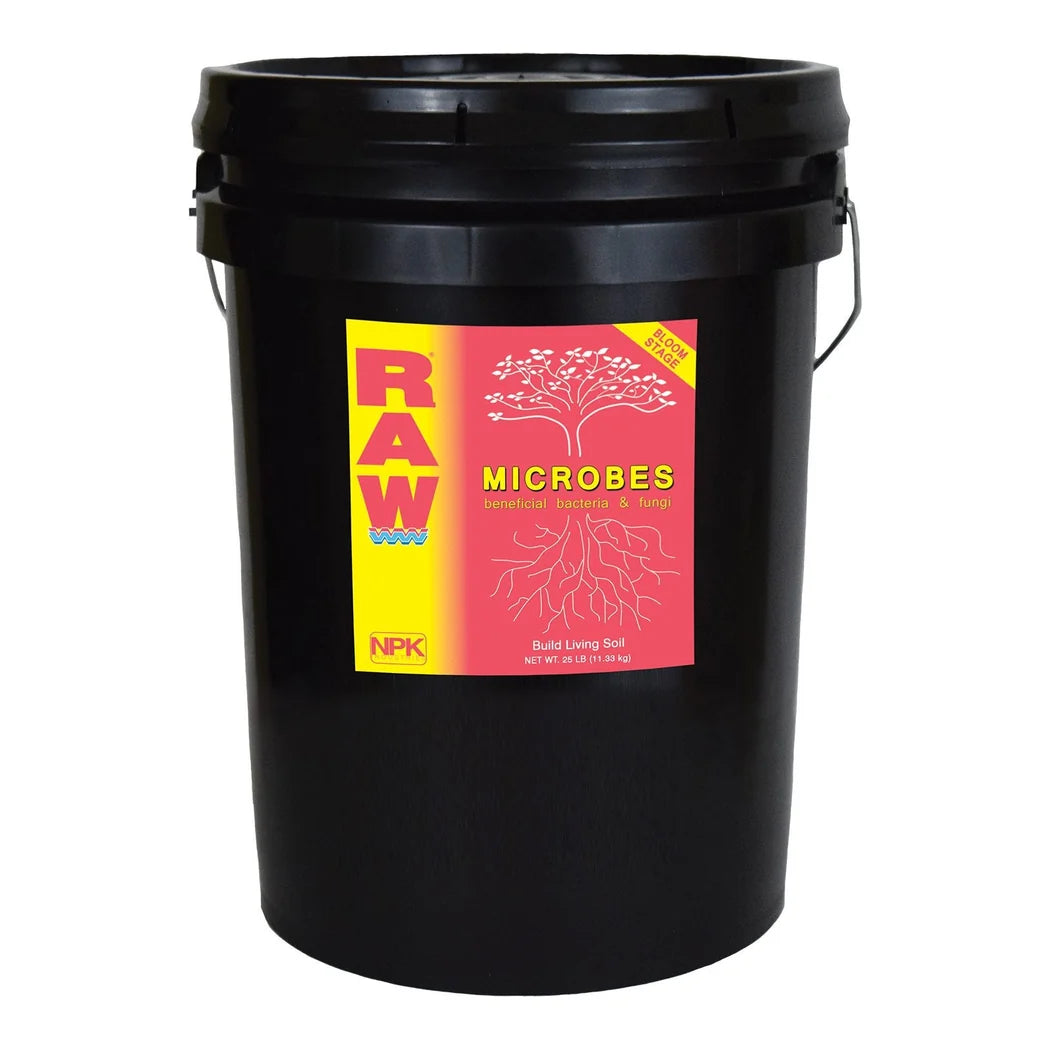
What Is Actually in RAW Microbes Bloom Stage
For a microbial inoculant the species list is the product, so start there: Bacillus, Paenibacillus, Pseudomonas, Streptomycetes and Trichoderma species. Those genera do different jobs and that is the point of a blend. Bacillus and Paenibacillus are the workhorses for solubilising phosphate and potassium that is present in the medium but locked up. Pseudomonas species are associated with iron availability and with crowding out pathogens at the root surface. Streptomycetes are filamentous and produce antimicrobial compounds, which is the plant protection half of the claim. Trichoderma is a fungus rather than a bacterium and colonises the root surface directly, competing for space with the organisms you do not want there. Every individual culture is tested, then the final blend is tested again.
Getting Beneficial Bacteria for Plants Into the Root Zone
The rate is half to one teaspoon per gallon of water or of completed nutrient solution, which works out around 0.65 to 1.3 mL per litre. It goes in during normal irrigation rather than as a separate operation, and a routine programme inoculates every one or two weeks. Little and often beats one heavy dose, because you are establishing a population rather than applying a chemical. Two things kill an inoculation and neither gets mentioned often enough. Chlorinated tap water is the first, so water that has been dechlorinated or filtered is what this should go into. Hydrogen peroxide and the various root-zone sterilisers are the second, and running them in the same reservoir makes the powder a waste of money. There is no guaranteed analysis and no NPK on this product, because it supplies organisms rather than elements. Sizes run 2 oz, 8 oz, 2 lbs, 10 lbs and 25 lbs, and the cost per pound falls steeply across that ladder. Store it sealed, dry and cool.
Key Features
- Five genera, named: Bacillus, Paenibacillus, Pseudomonas, Streptomycetes and Trichoderma.
- For the flowering half: A different blend from the Grow stage product in the same range.
- Half to one teaspoon a gallon: Roughly 0.65 to 1.3 mL per litre of finished solution.
- Every one to two weeks: Establishing a population, not applying a one-off chemical.
- Tested twice: Each culture individually, then the final blend again.
- No NPK and no analysis: It supplies organisms rather than elements, so there is none to state.
- Not with chlorine or peroxide: Dechlorinated water only, and no root-zone steriliser alongside.
- Five sizes: 2 oz through to 25 lbs, with cost per pound falling steeply.
Technical Specifications
| Specification | Value |
|---|---|
| SKU, 2 oz | 717978 |
| SKU, 8 oz | 717980 |
| SKU, 2 lbs | 717982 |
| SKU, 10 lbs | 717984 |
| SKU, 25 lbs | 717985 |
| Brand | NPK Industries |
| Product | Soluble powder microbial inoculant, flowering stage |
| Species | Bacillus, Paenibacillus, Pseudomonas, Streptomycetes, Trichoderma |
| Guaranteed analysis | None; this is an inoculant, not a fertiliser |
| Rate | Half to one teaspoon per gallon, around 0.65 to 1.3 mL per litre |
| Frequency | Every one to two weeks with normal irrigation |
| Goes into | Water or completed nutrient solution |
| Avoid | Chlorinated water, hydrogen peroxide and root-zone sterilisers |
| Testing | Each culture tested individually, then the final blend |
| Sizes | 2 oz, 8 oz, 2 lbs, 10 lbs, 25 lbs |
| Storage | Sealed, dry and cool |
| Stage sibling | RAW Microbes Grow Stage, for the vegetative half |