


What Is Actually in Sour-Dee 0-0-2
The guaranteed analysis on this product is one line long, and that is the most useful fact about it. Soluble potash sits at 2.0 percent. Nitrogen and phosphorus are both zero, which is what the name says. Everything else in the jug is sugar. The derived from statement is 2% sucrose from evaporated cane juice and molasses. That fraction is there as microbe food. So this is not a feed and it was never meant to replace one. It is a late season additive that puts a small amount of potassium in alongside a carbohydrate load. Knowing that changes how it should be budgeted. A bloom booster with real phosphorus and potassium behind it is a different bottle entirely. The right grower for it already has a base feed dialled in. What they want is support for root zone biology through the stretch and into ripening. One practical consequence follows from the sugar being the bulk of it. A jug left open, or stored somewhere warm, can start to ferment on its own. Keep the cap on and keep it out of the heat. A jug that has been standing since last season is worth checking before it goes in a tank.
Using It as a Carbohydrate Source for Flower
The dose is modest and specific. Reservoir feeding is 10 mL per gallon of made up solution. Through an injector the ratio is one to three hundred and seventy five, which Cutting Edge also express as 0.26%. Sour-Dee 0-0-2 is a flower phase product. It goes in once the plant has set and is building, rather than at the start of veg. Now the part that matters with any sugar additive. Carbohydrate in a root zone feeds whatever is living there, and that includes organisms nobody wanted. In living soil or a coco bed with an established microbial population that is the point and it works. In a clean recirculating hydro reservoir it is a different proposition, because sugar plus warm water plus light is how biofilm starts. If the tank runs above about seventy degrees, or if it has had slime problems before, go in at half rate and watch the lines. Keep the reservoir dark and keep it cool. The other practical note is mixing order. Add it after the base nutrients are in and dissolved, rather than into raw water. Give it a stir instead of trusting the pump to do the job.
Key Features
- Guaranteed analysis is one line: Soluble potash at 2.0 percent, with no nitrogen and no phosphorus.
- The rest is sucrose: From evaporated cane juice and molasses, which feeds soil microbes.
- A supplement, not a base feed: It goes in alongside a feed rather than instead of one.
- Flower phase: It belongs in the second half of the cycle, not in veg.
- 10 mL per gallon: Or one part in three hundred and seventy five through an injector.
- Half rate in warm hydro: Sugar in a warm, lit reservoir is how biofilm gets started.
- Mix it in last: After the base nutrients are dissolved, and stir rather than relying on the pump.
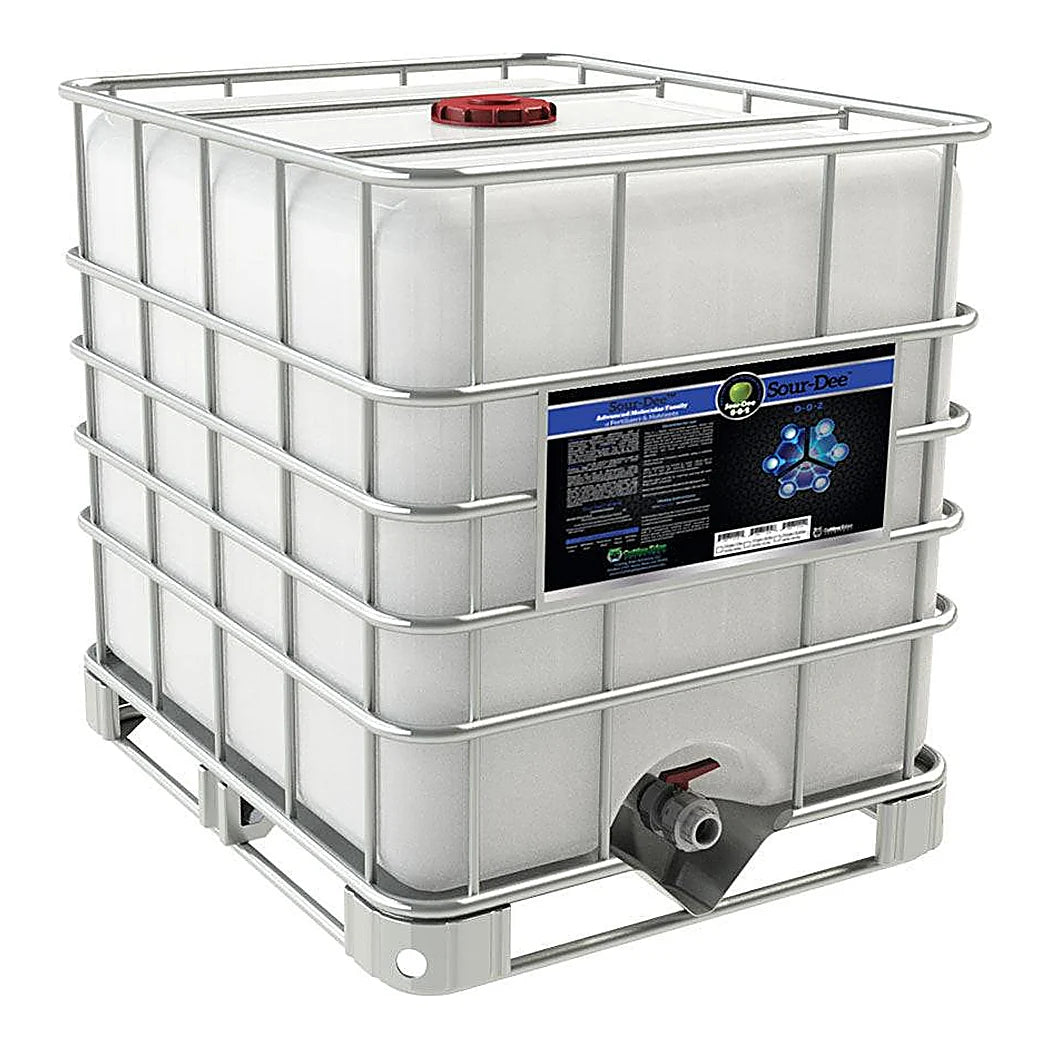
- Pack sizes: From a quart up to a 270 gallon tote.
Technical Specifications
| Specification | Value |
|---|---|
| SKU, 1 gallon | CES3302 |
| SKU, 2.5 gallons | CES3303 |
| SKU, 6 gallons | CES3304 |
| SKU, 20 gallons | CES3305 |
| SKU, 55 gallons | CES3306 |
| Brand | Cutting Edge Solutions |
| Product | Flower phase carbohydrate and potassium supplement |
| Guaranteed analysis | Soluble potash (K2O) 2.0% |
| N-P-K | 0 - 0 - 2 |
| Derived from | 2% sucrose from evaporated cane juice and molasses |
| Sugar function | Microbe food |
| Growth stage | Flower |
| Reservoir rate | 10 mL per gallon of made up solution |
| Injector ratio | 1:375, or 0.26% |
| Coverage, 1 gallon | Roughly 378 gallons of solution at the standard rate |
| Coverage, 2.5 gallons | Roughly 946 gallons of solution |
| Coverage, 6 gallons | Roughly 2,271 gallons of solution |
| Coverage, 55 gallons | Roughly 20,800 gallons of solution |
| Pack sizes | 1 qt, 1 gal, 2.5 gal, 6 gal, 15 gal, 55 gal barrel, 270 gal tote |
| Barcode, 1 gallon | 817867010161 |
| Barcode, 2.5 gallons | 817867010277 |
| Barcode, 6 gallons | 817867010376 |
| Barcode, 20 gallons | 817867011397 |
| Barcode, 55 gallons | 817867010598 |